Enter Password

Hint: Interest? Contact Me!

PropertySearch.com

UAE Lifestyle Super App

In August 2025, I joined the Unmarketing Agency company as a Junior UI/UX Designer and started working on PropertySearch.com from day one. The project covered the full design process research, strategy, wireframing, HiFi design, and presenting work to the client. I worked closely with the backend, frontend, and AI/ML teams throughout, learning to translate technical constraints into design decisions that worked for everyone.

Midway through the project, the scope changed significantly what began as a property portal expanded into a full lifestyle super app covering 8 service categories across the UAE. It was the biggest pivot I've experienced in a professional setting, and by far my most valuable learning from this project

Timeline:

Sept 2025 - Ongoing

Status

Under Development

My Role:

Jr. UI/UX Designer

Market:

UAE (Dubai & 7 Emirates)

Tools

Figma, FigJam, Figma Make, Photoshop, Illustrator, GPTs, Nano Banana

Note

This project is currently under active development and has not launched. Some data, partner names, and specifics have been slightly adjusted to maintain confidentiality. The design work, decisions, and process shown here are accurate representations of my actual contributions to the project.

Team & My Role

I worked as a Junior UI/UX Designer under a Lead Designer and Product Manager, contributing across research, user flows, wireframing, and HiFi screens. The wider team included frontend, backend, and AI/ML engineers. I worked closely with all of them throughout the project. Where this case study says "I," it reflects work I directly contributed to within my junior role; all major decisions were reviewed and signed off by the Lead and PM.

A Story Worth Telling

Real-world innovation is rarely a straight line. This isn't just a case study of a design file; it’s the story of a team that recognized a market gap and had the courage to pivot.

It started as a clear, focused directive. Our team was tasked with building a robust competitor to UAE’s property giants like Property Finder and Bayut. We set out to create a platform built on transparency, trust, and data accuracy - a "Utility Tool" to help people find & invest in homes.

But midway through the project, the stakeholders identified a critical missed opportunity. They realized that finding a house was only 10% of the struggle. The real pain and the real business potential began after the contract was signed, amidst the disconnected chaos of movers, maintenance, bills, and lifestyle needs.

The decision came down from the stakeholders: a simple listing aggregator wasn't enough. To build a true "Data Moat" and create value that lasted, the business needed to go beyond the transaction.

The project mandate shifted overnight. We were no longer building a property website; we were tasked with architecting a Super App Ecosystem. Our team had to pivot instantly, expanding our focus from solving "Search" to solving "Living."


Phase 1

Property Portal

Research, IA, user flows, competitive analysis, wireframes, and HiFi screens for a UAE real estate platform. Work approved by client. Pivoted to Phase 2.

Phase 2

Lifestyle Super App

Complete product pivot. New personas, new IA, 5-flow design system, 30+ service categories across all UAE emirates. Currently in development

Project Overview

PropertySearch.com is a UAE-based company that began its journey as a real estate search portal and based on stakeholder direction, transformed into a lifestyle super app. It assists users in their search, purchase, rental, and investment in property, while also providing them with access to their daily life needs, such as home maintenance, moving, government administration, mobility, healthcare, and much more. It is a platform that is there for all of it, with AI enabling both search and analytics to assist users in making decisions based on data.

What is the problem?

Residents of the UAE go about their lives with dozens of fragmented apps, one for property, one for buying groceries, one for a car wash, one for visa renewal, and so on. There is no one app that ties together high-value experiences (e.g., buying a house) and low-value experiences (e.g., booking a maid).

The real UX problem was not the design of the features but rather the cohesiveness of the features. If it's harder to book a maid service with us than with JustLife, users won't use us. If the search for properties is not better than Bayut, users won't trust it. Each service had to be better than the best-in-class app for that service or the whole value proposition falls apart.

What are we solving?

What are the challenges?

Working on real-world complexity for the first time at this scale

Leaning heavily on the research phase to build my own mental model before touching UI. Understanding the Five-Flow system gave me a framework that made the scale feel manageable.

Adapting when the product direction changed mid-project

Staying closely aligned with the Lead Designer and PM during the pivot, asking questions early, and using Phase 1 research as a foundation rather than treating it as wasted effort.

Producing research and design work that met professional standards

Treating every review cycle as a learning opportunity. Using competitor analysis not just for inspiration but to understand why certain patterns exist building design rationale, not just collecting screenshots.

Designing for a market and culture I was still learning

Deep competitive analysis of UAE-specific platforms (Bayut, DubaiNow, Careem) as primary references not just global apps. Letting local market patterns guide decisions over personal instinct.

What design process we followed?

Discover

Market research · Analysis

Define

Personas · IA · User flows · Feature decisions

Design

LoFi wireframes · Figma Make explorations

Deliver

HiFi screens · Client approval

Reset

Product scope reframed · Super App

Lean UX

Fast research loops · Rapid prototyping

Phase 1 - Property Portal

About UAE real estate market

UAE's real estate market operates at a scale and complexity unlike any Western market. A large share of buyers are non-residents making six-figure decisions remotely without the ability to visit in person, without established local trust networks, and without access to transparent pricing data. Off-plan purchases are common. Regulation is strict: every listing legally requires DLD/RERA permits, agent licenses, and QR-verifiable documentation. This created a massive gap between what users needed and what existing platforms were offering.

Coverage

Dubai

Abu Dhabi

Sharjah

Ajman

Al Ain

Ras Al Khaimah

Umm Al Quwain

Fujairah

Expatriate Investors

22%

primarily Indian, British, and Russian nationals

Emirati National

Long Term Focus

Focused on long-term family homes, inter-generational wealth, and privacy in specific communities

What our User Research say

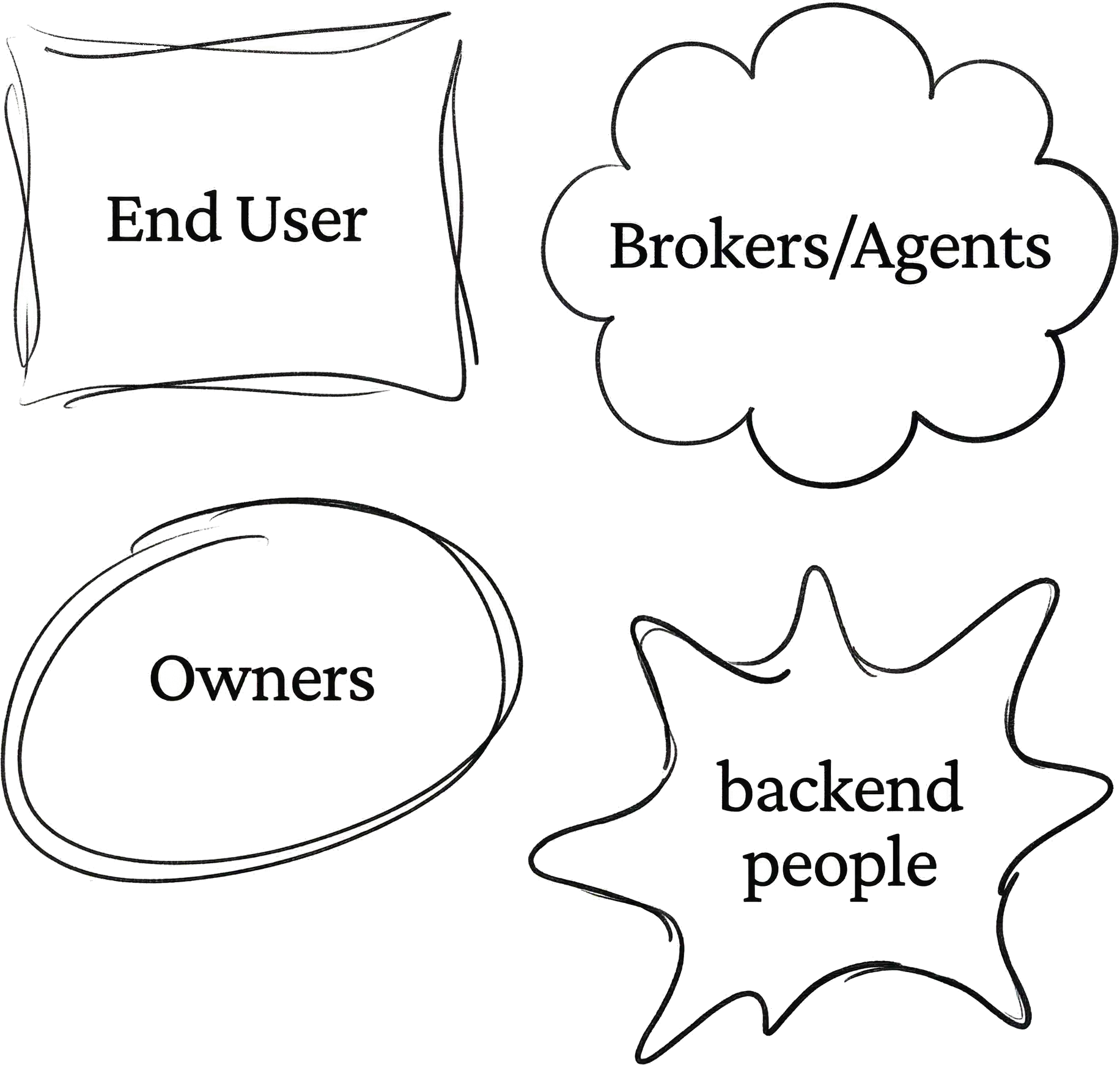
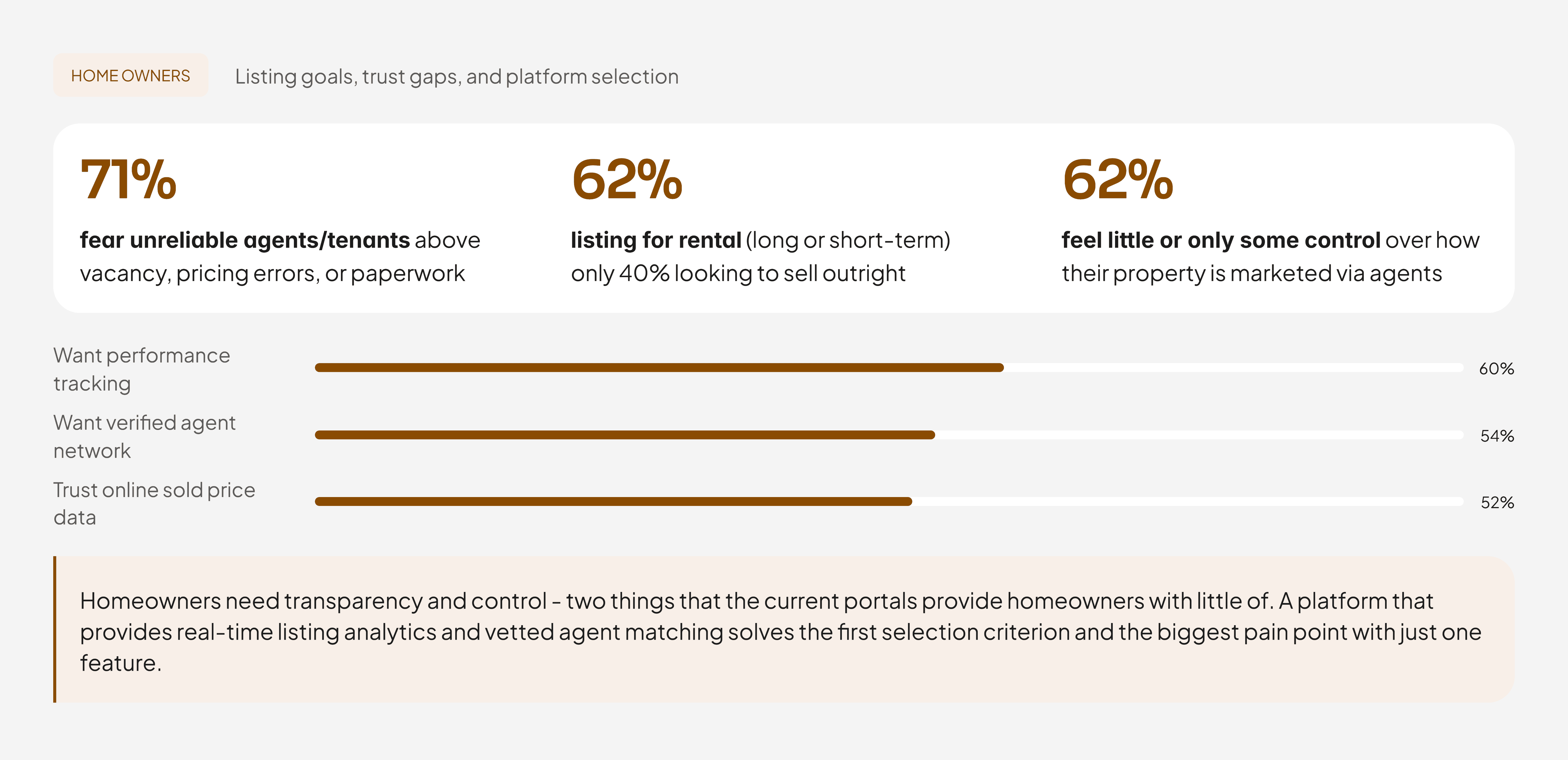
To guarantee that our design decisions were based on real user needs rather than supposition, we aggregated our market research into different archetypes that encompassed all sides of our multi-sided platform. This is because a successful real estate platform requires more than just buyers. We designed the goals and pains for seekers, owners, and backend administrators to provide a complete scope for our prioritization of the entire product suite.

Who is going to use PS portal

Validating research & point

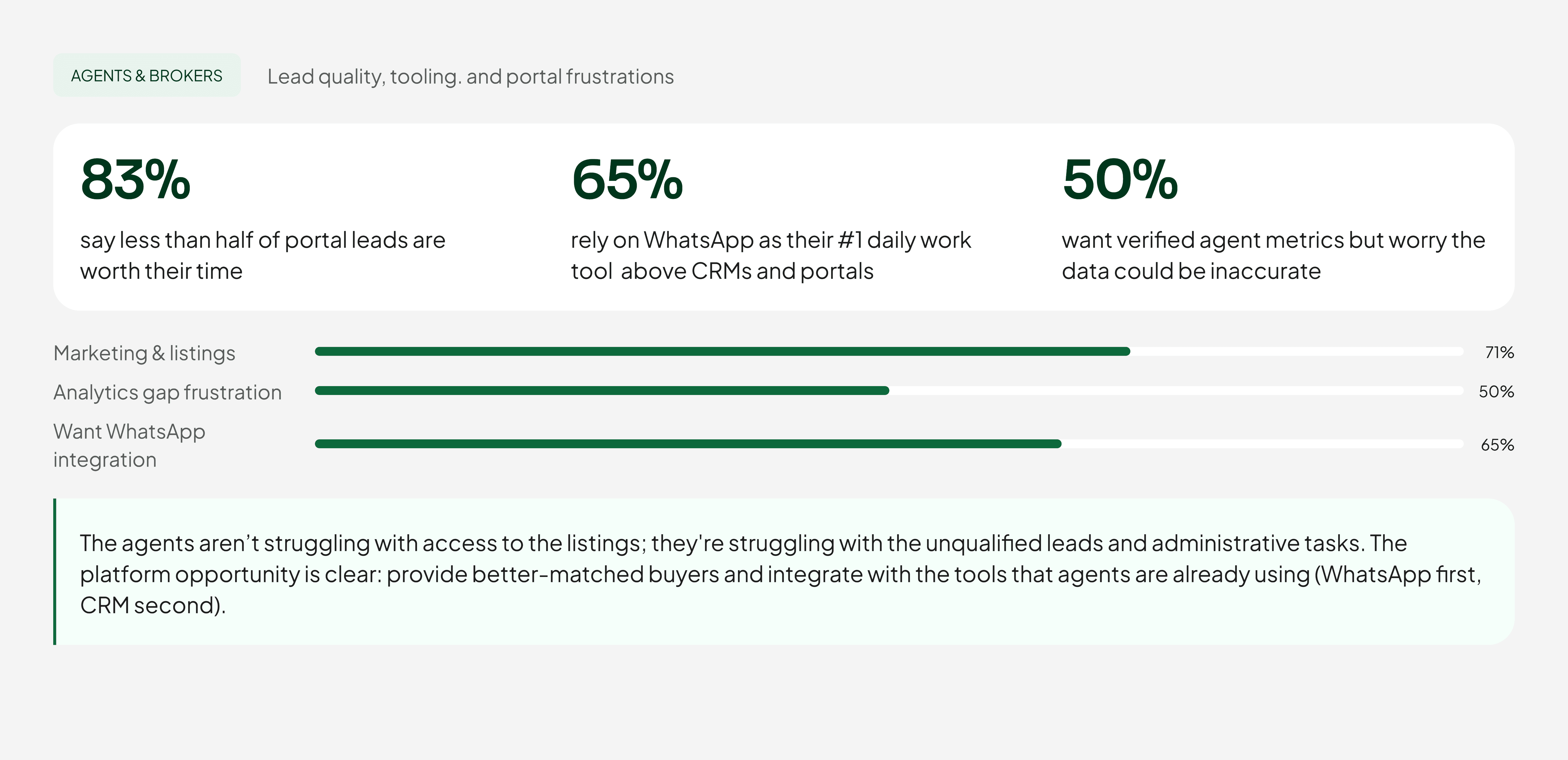
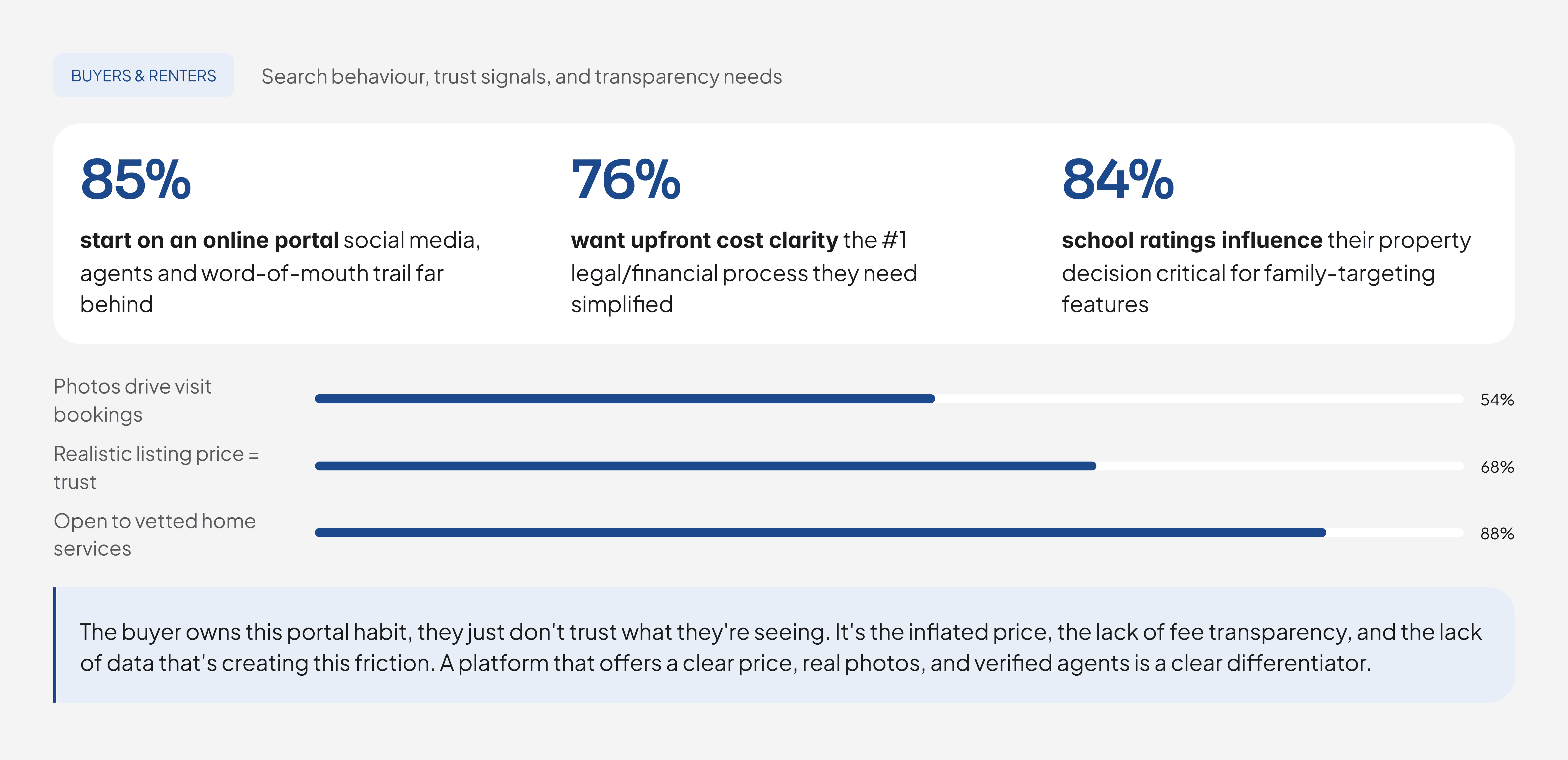
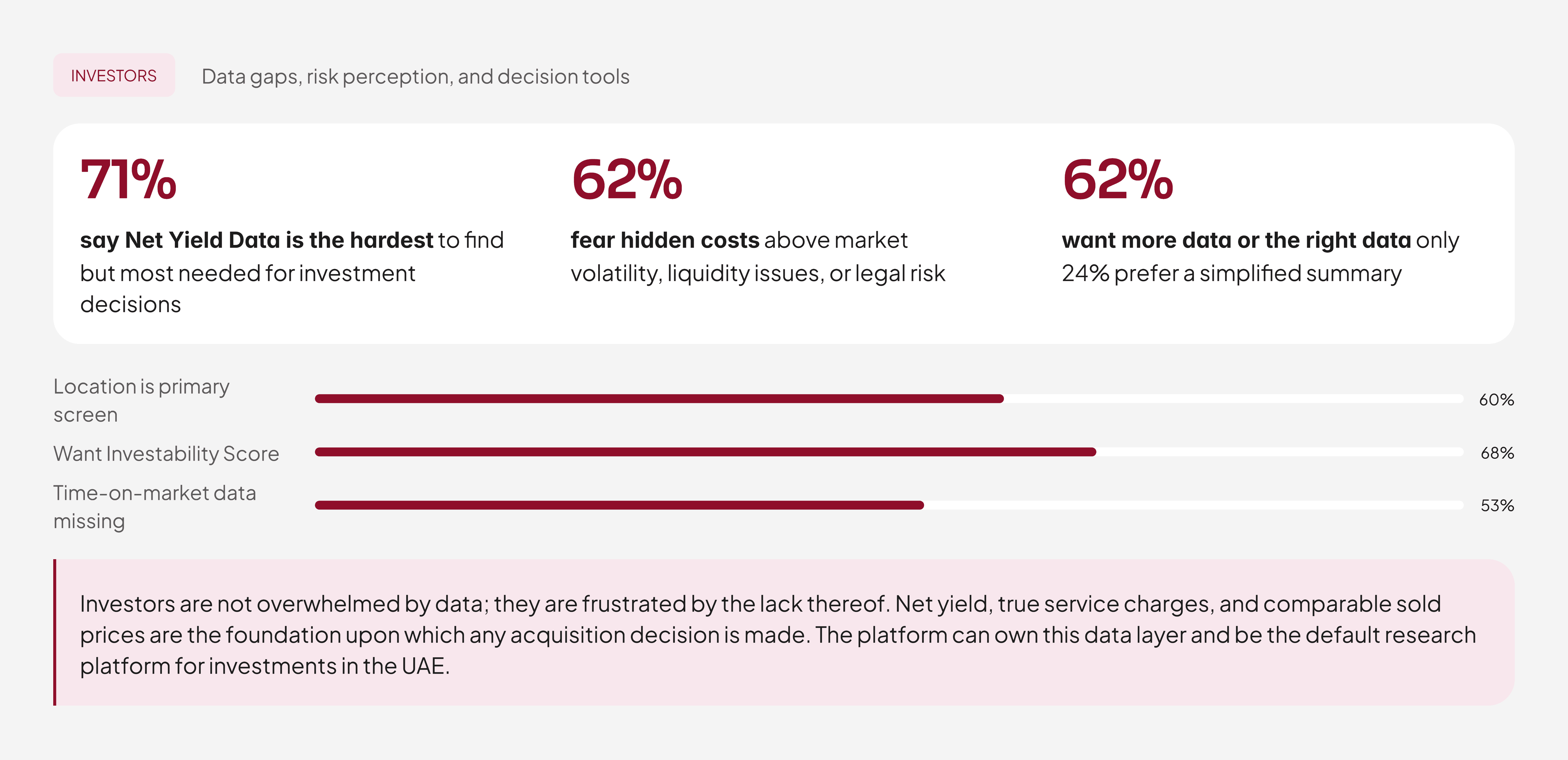
I analyzed data from UserQ and local forums to pinpoint exactly where competitors were failing & I have shown the analytics of survey result

Four design decisions directly supported by survey evidence

Lead quality over lead quantity

83%

agents receive mostly unqualified leads.

Total cost transparency as a core feature

76%

Buyers

54%

Investors

76%

Buyers

54%

Investors

cite for hidden costs as their primary pain.

Verification drives conversion for all segments

Buyers want verified agents. Owners want verified tenants. Investors want verified data. A unified verification layer underpins the entire platform's value proposition.

Data depth beats data simplification

71%

want more or better-targeted data.

Property Buying behavior

A major factor differentiating behavior is the distinction between UAE nationals and UAE residents/ non-residents.

UAE nationals

Domestic Buyers

"Emirati buyers are not just purchasing a house they are securing a legacy, building a home their family will live in for generations."

~Primary Goal

"They strongly prefer spacious villas in suburban or waterfront communities places that feel like a true home, not just an investment unit."

~Property Preference

"Their investment style is patient and deliberate focused on prime, established areas with a proven track record rather than chasing quick returns."

~Investment Style

"Emirati nationals benefit from government-backed mortgage schemes and preferential rates that give them a clear financial advantage in the market."

~Financing

"At the core, they are driven by a sense of community, cultural identity, and the desire to maximise the size and quality of their family's living space."

~Key Driver

UAE residents/ non-residents

Foreign Investors

"For expat buyers, property in the UAE is both a financial instrument and a pathway most are here for rental yields, capital growth, and the Golden Visa."

~Primary Goal

"They gravitate towards urban apartments in high-demand areas like Downtown Dubai and the Marina locations that attract strong rental demand year round."

~Property Preference

"Expats often target off-plan developments for early-entry pricing they are willing to take on more risk in exchange for the potential of significant short-term gains."

~Investment Style

"The absence of capital gains tax and personal income tax is a massive draw it fundamentally changes the net return calculation compared to any other global market."

~Financing

"What ultimately pulls them in is the combination of financial freedom, global safe-haven status, and the allure of a luxury, cosmopolitan lifestyle that the UAE uniquely offers."

~Key Driver

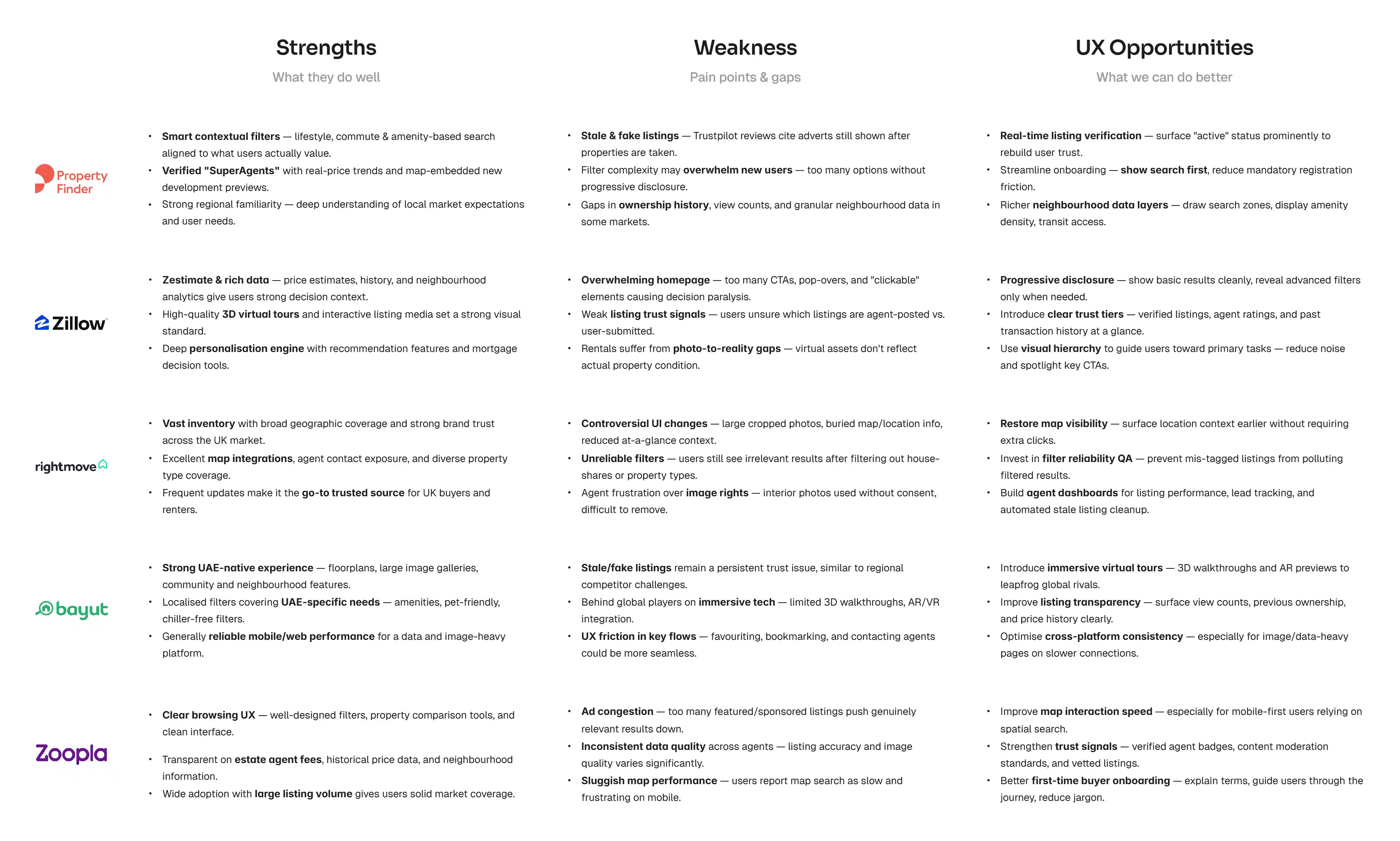
What our Competitor analysis shows

User Flow

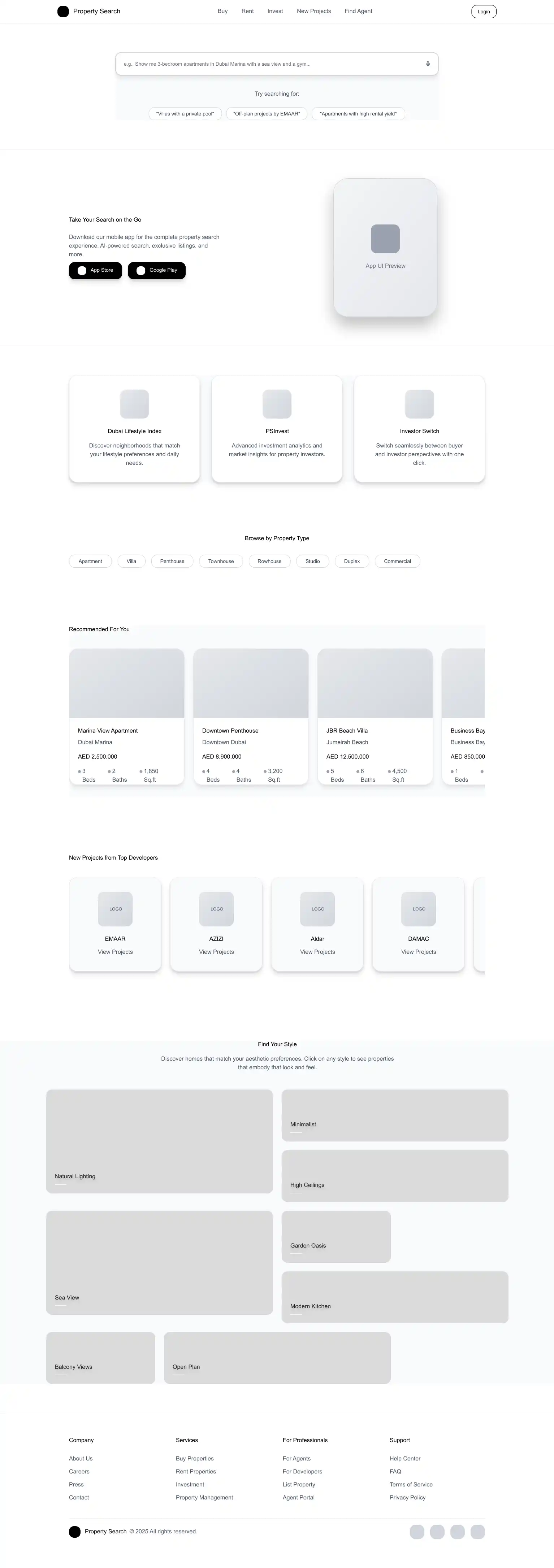
With team, we develop the user flow to know the screens see the future flows, and organize the ideas that we had for the website.

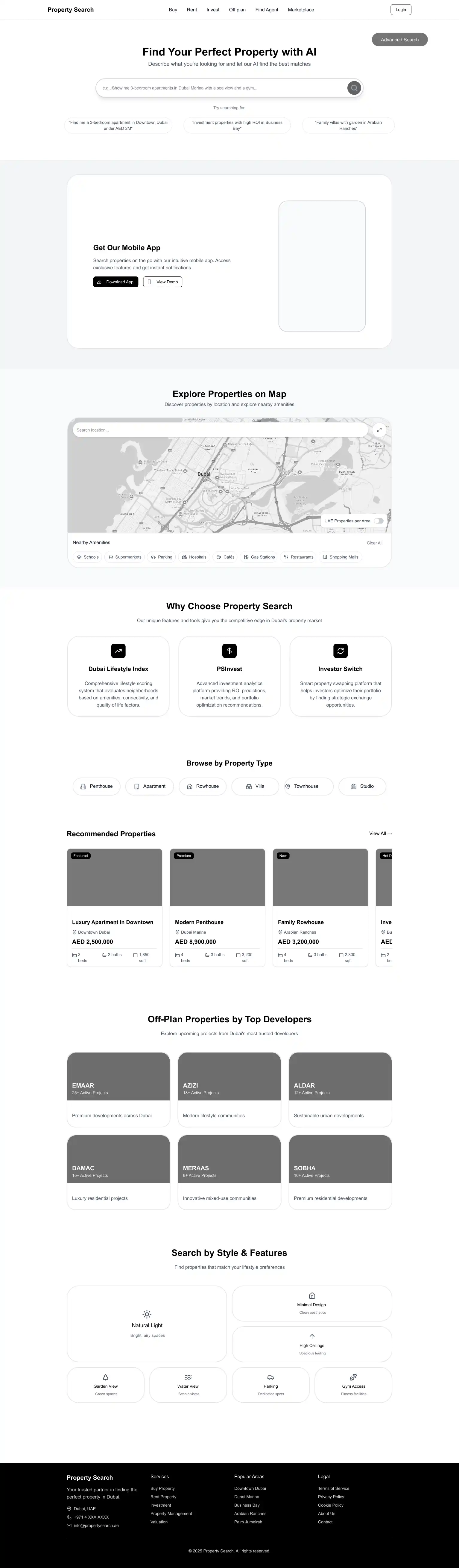
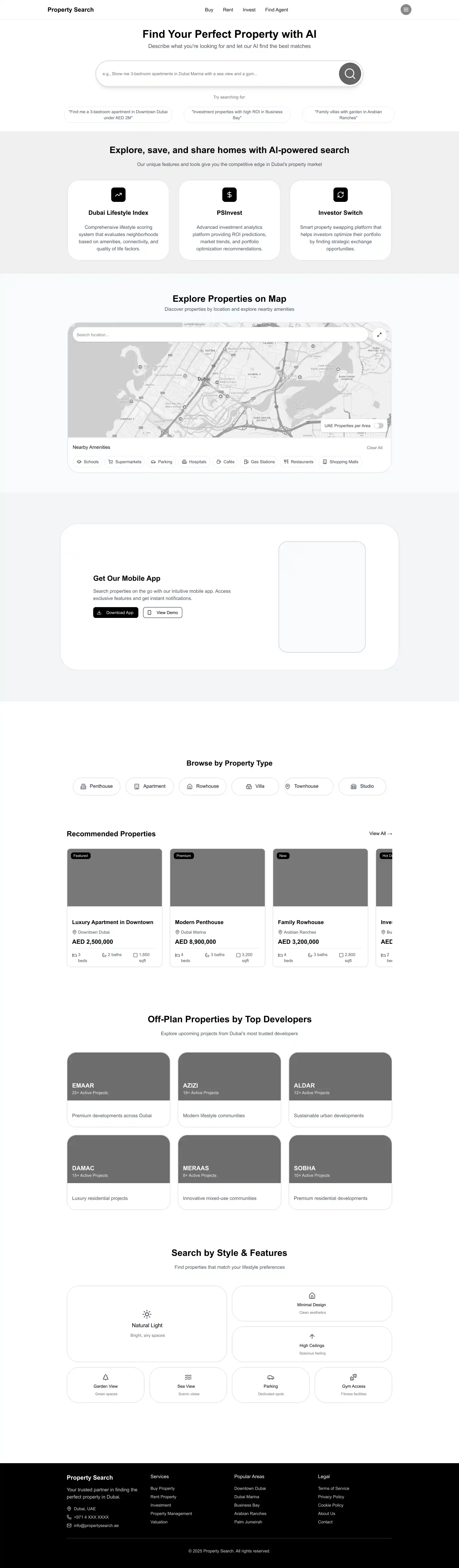
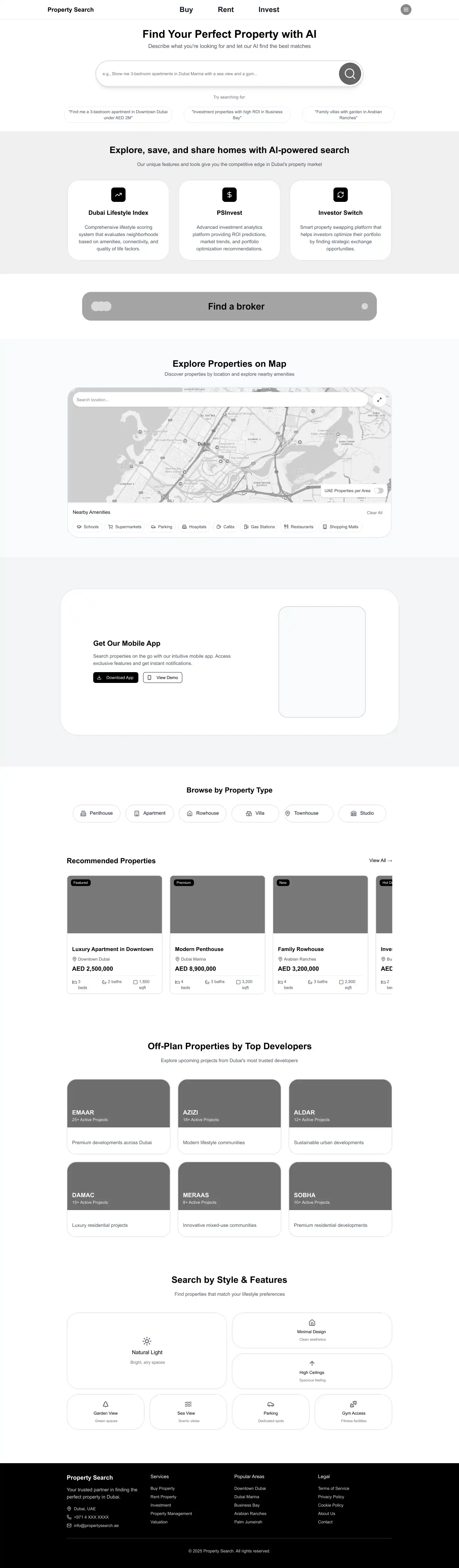
Low-fidelity designs

For Lo-fi phase of this project, I used Figma Make. Figma Make is an AI-powered generation tool by Figma. This allows me to speed up the process of wireframe and layout directions.

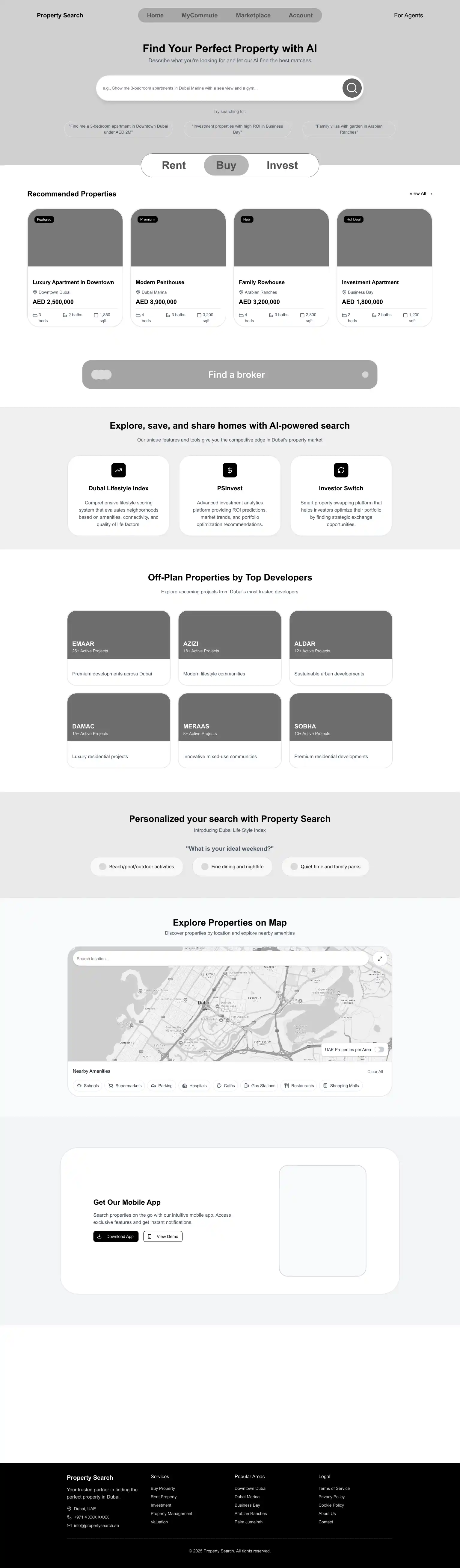
Lofi Website Homepage Screens

Feature Tools Lofi Designs

Phase 1 - Designs

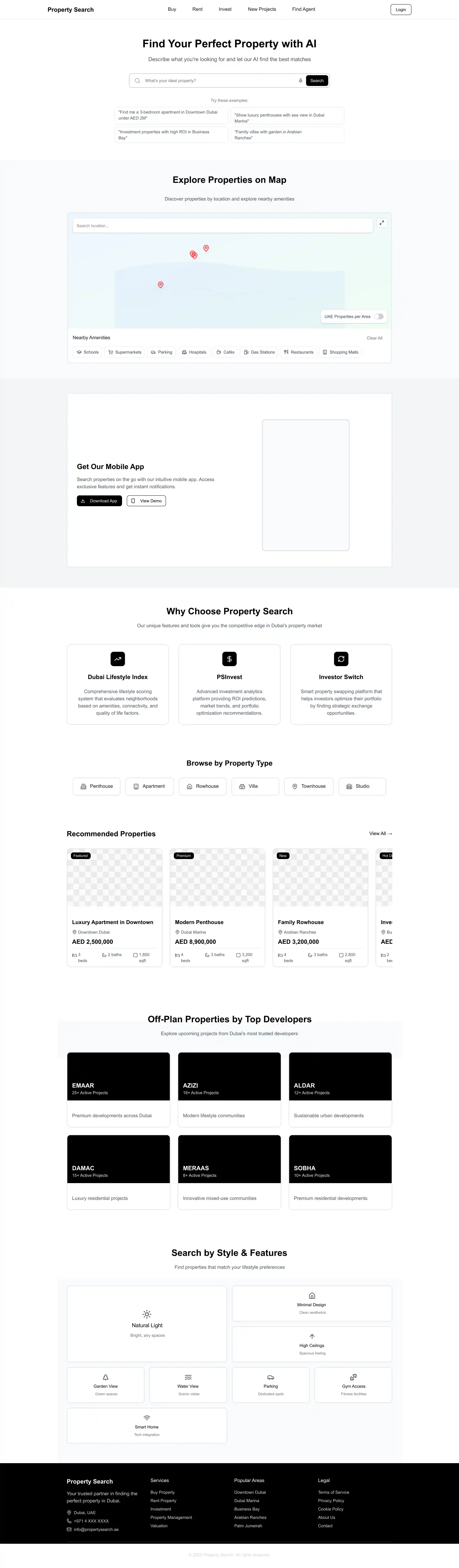
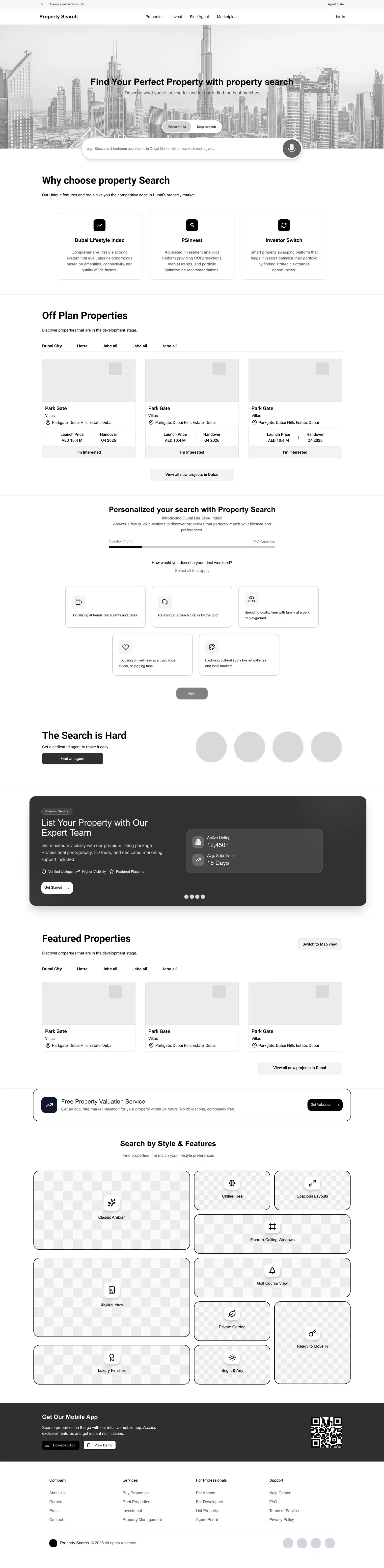
Homepage

The homepage was designed to make a strong first impression communicating the product's premium feel and vision right from the start. Beyond the look, it needed to clearly show what the platform actually does: crypto-enabled transactions, lifestyle-based property search, browsing by emirate, and the AI-powered tools that set it apart.

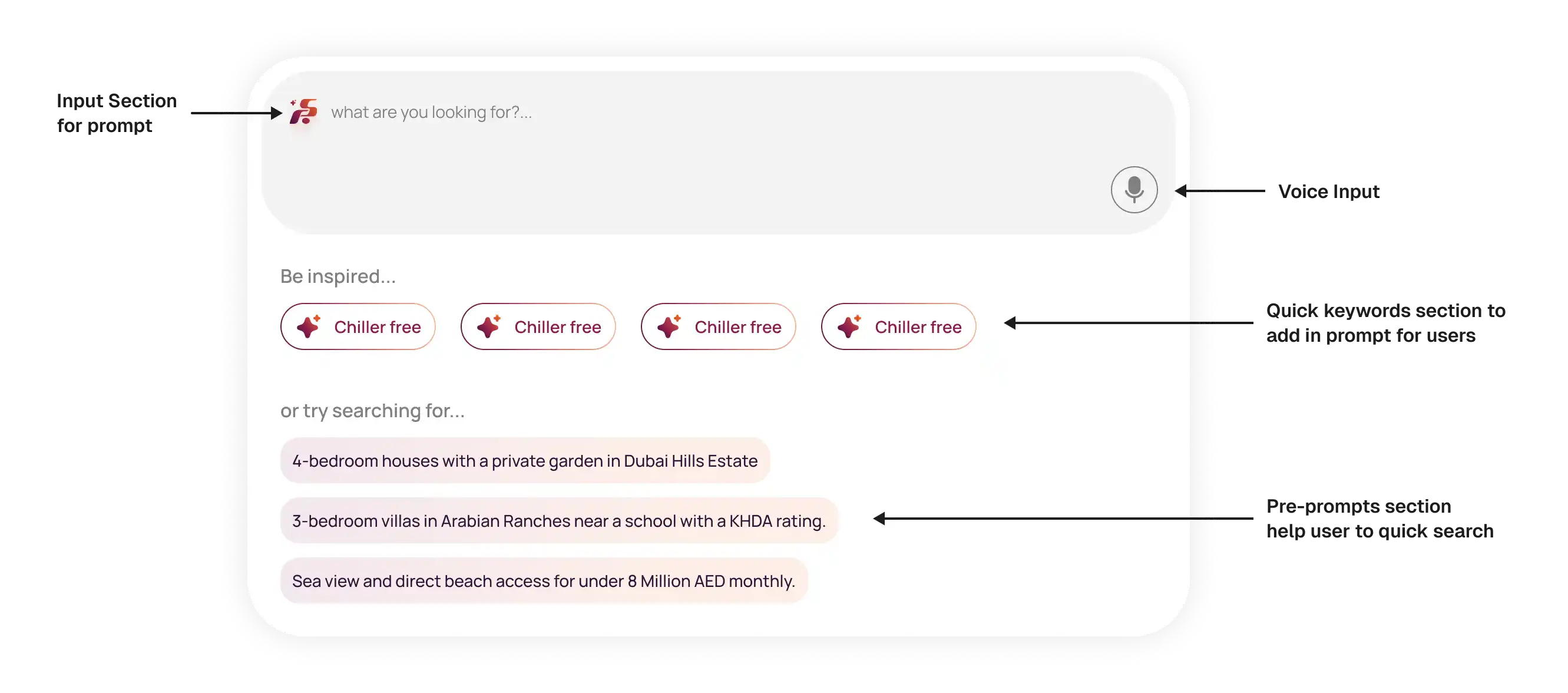
AI Search

Most property searches are like filling out a form, where you enter the bedrooms, budget, area, and then hit 'go.' The idea behind the AI search was that it should feel different. You should type what you think and we should understand what you mean. The "be inspired" and "try searching for" suggestions were intended to help those who don't know what to type get to the right answer faster. The idea was not just to speed up the results, but to reduce the effort of the search.

Ai Search Bar

AI Search Expanded

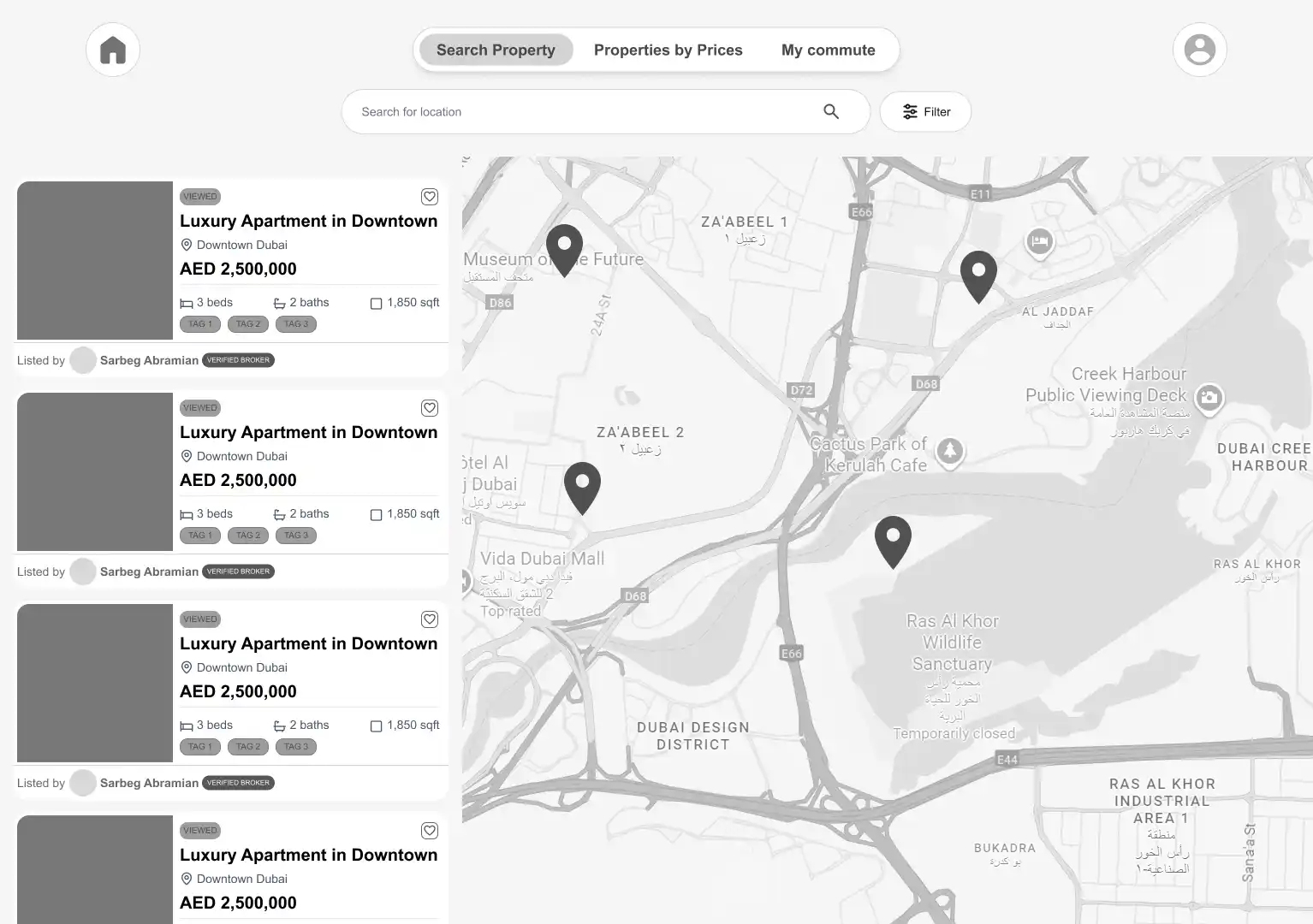
Search by Map

The map search feature allows you to do just that: look at properties on a map, zoom in on a neighborhood you like the look of, and see what's for sale without having to type a single key. It's a more intuitive way to search for people who think spatially.

Commute Tool

The commute tool allows you to see what's really out there. You want to know how far it really is from this property to work, to school, to the gym. You want to know the travel time, not just the distance. And if you're choosing between two or three properties, you can see them one against the other same destination, different starting points to see which one really makes your life easier.

Prosight

It is difficult to understand the UAE property market as it is a fast-moving market and not always clear whether a price is fair, overpriced or a bargain. Prosight was created to take away the guesswork. It is embedded directly into the property listing page and provides users with three key elements: a tool to see how a property has changed in price over time, a mortgage calculator to see how much a property would cost to buy and own, and an AI generated feature that provides users with an understanding of how well a property is performing against others around it. It is all powered by AI and uses real data to ensure users get a clear understanding of a property, not just a number.

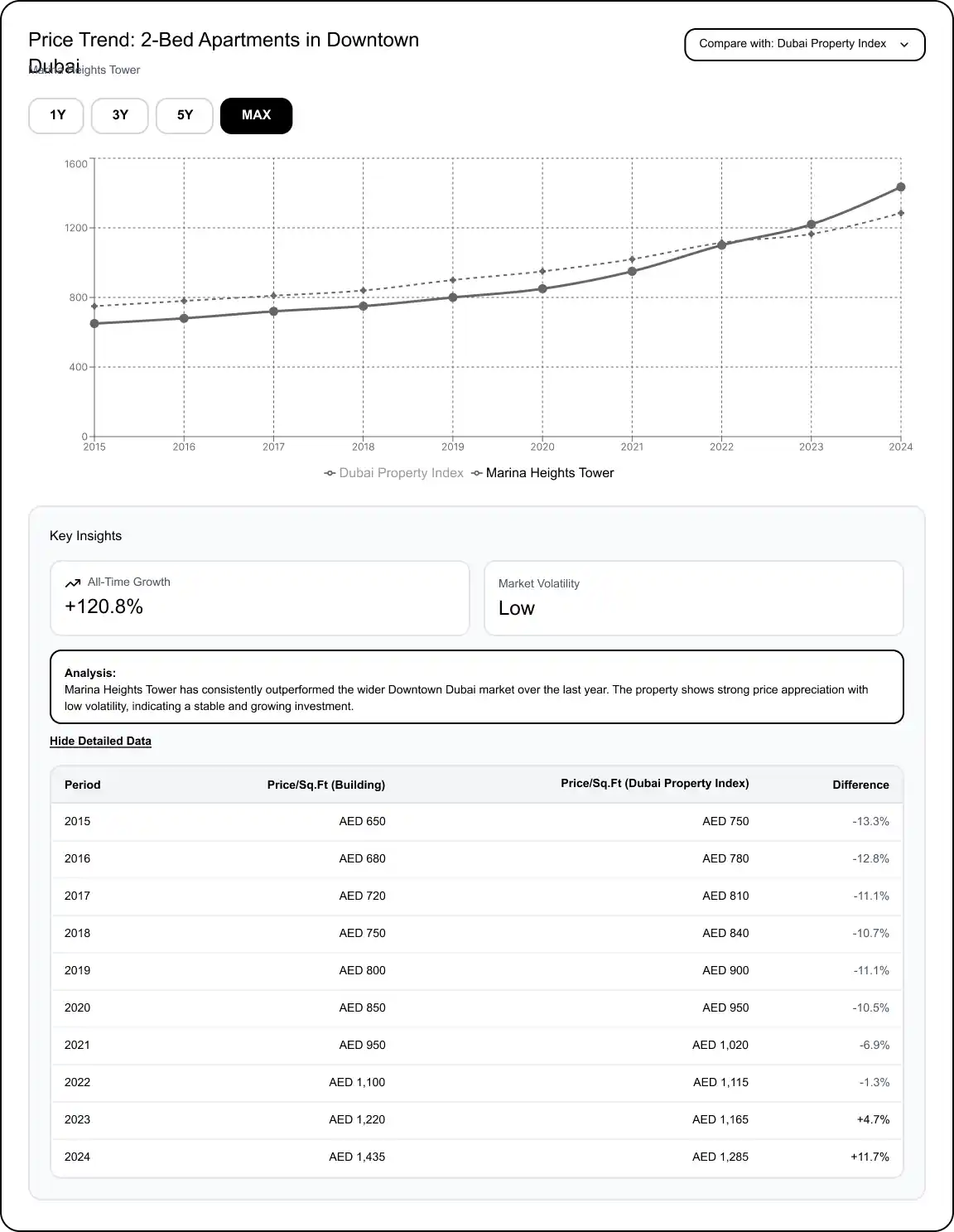
Price Trend Analysis

A price trend analysis chart shows the change in the cost of the specific building over time compared to the community as a whole, and an AI-generated summary below.

Mortgage Calculator

With Mortgage Calculator, enter property price, down payment, loan term, and interest rate, and get results for monthly payment, total upfront cash required and an AI verdict on whether it is Good, Stretched, or High Burden.

Closing Dashboard

An itemised breakdown of the entire process of completing the purchase of the property. For new users it will guide which documents will required for each steps.

Investor Switch

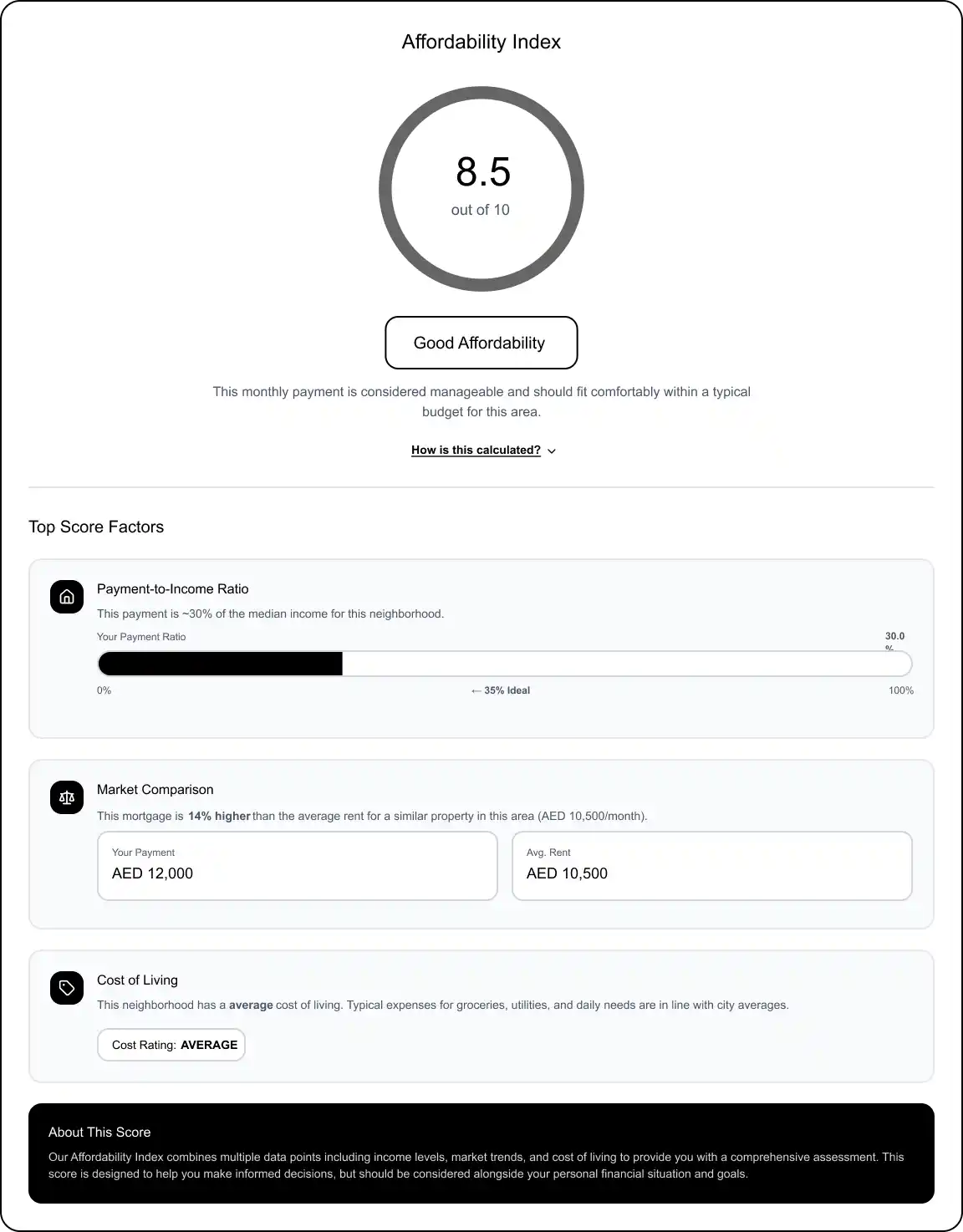
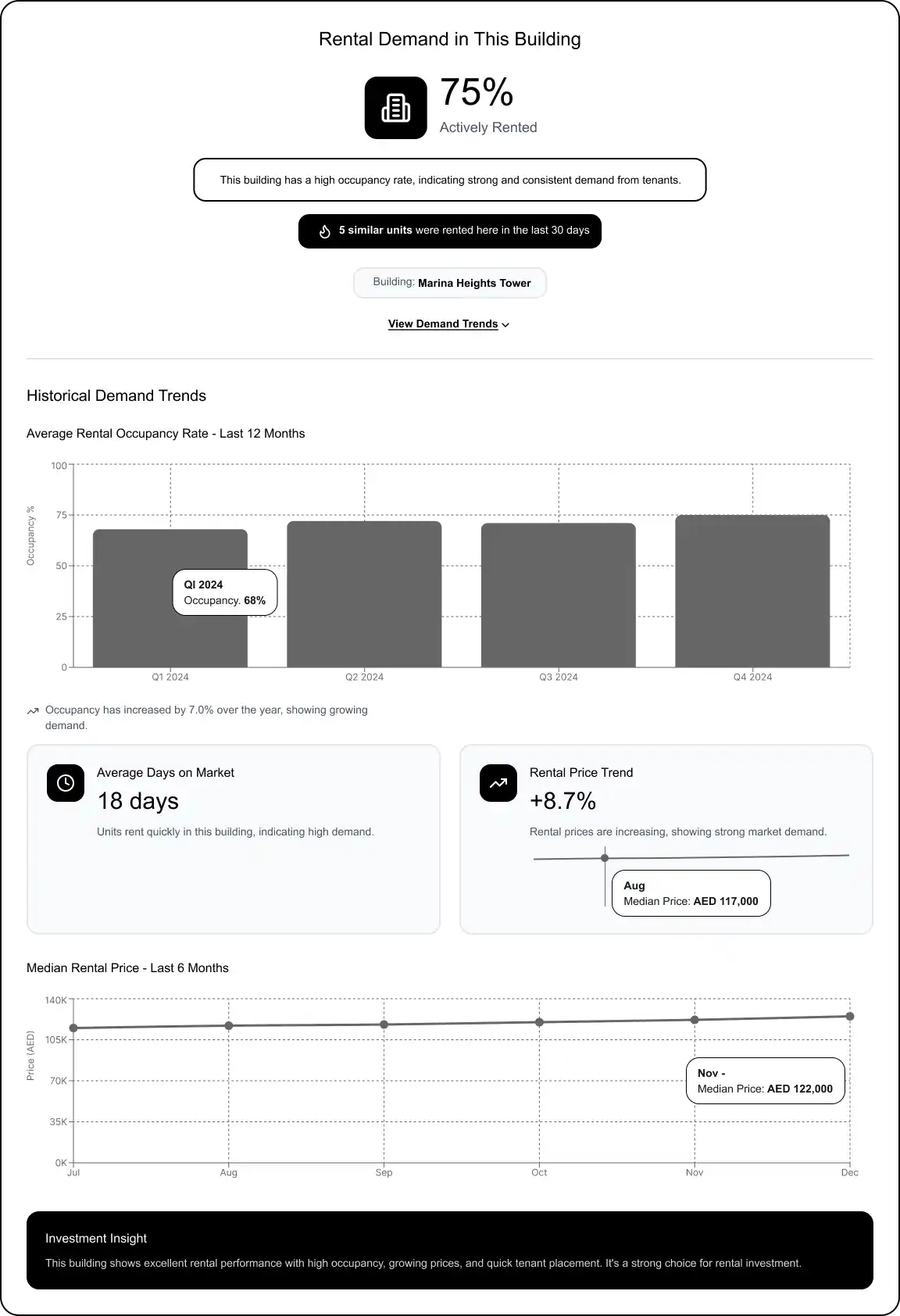
Investor Switch is a login specific tool designed for investors, bringing together four calculators/comparison tools that address the real questions investors want answered, such as how much money this investment will make for me, when is the right time to sell this investment to make money, and how does this compare to renting it out short or long-term? It all works on the back of AI analysis based on real data, so investors can get estimated numbers they can use.

Investment Calculator

Calculates a property's true earnings by working top down: Gross Rental Income -> Net Operating Income -> Net Cash Flow -> Net Rental Yield %. Gives investors a number that will help to take decision.

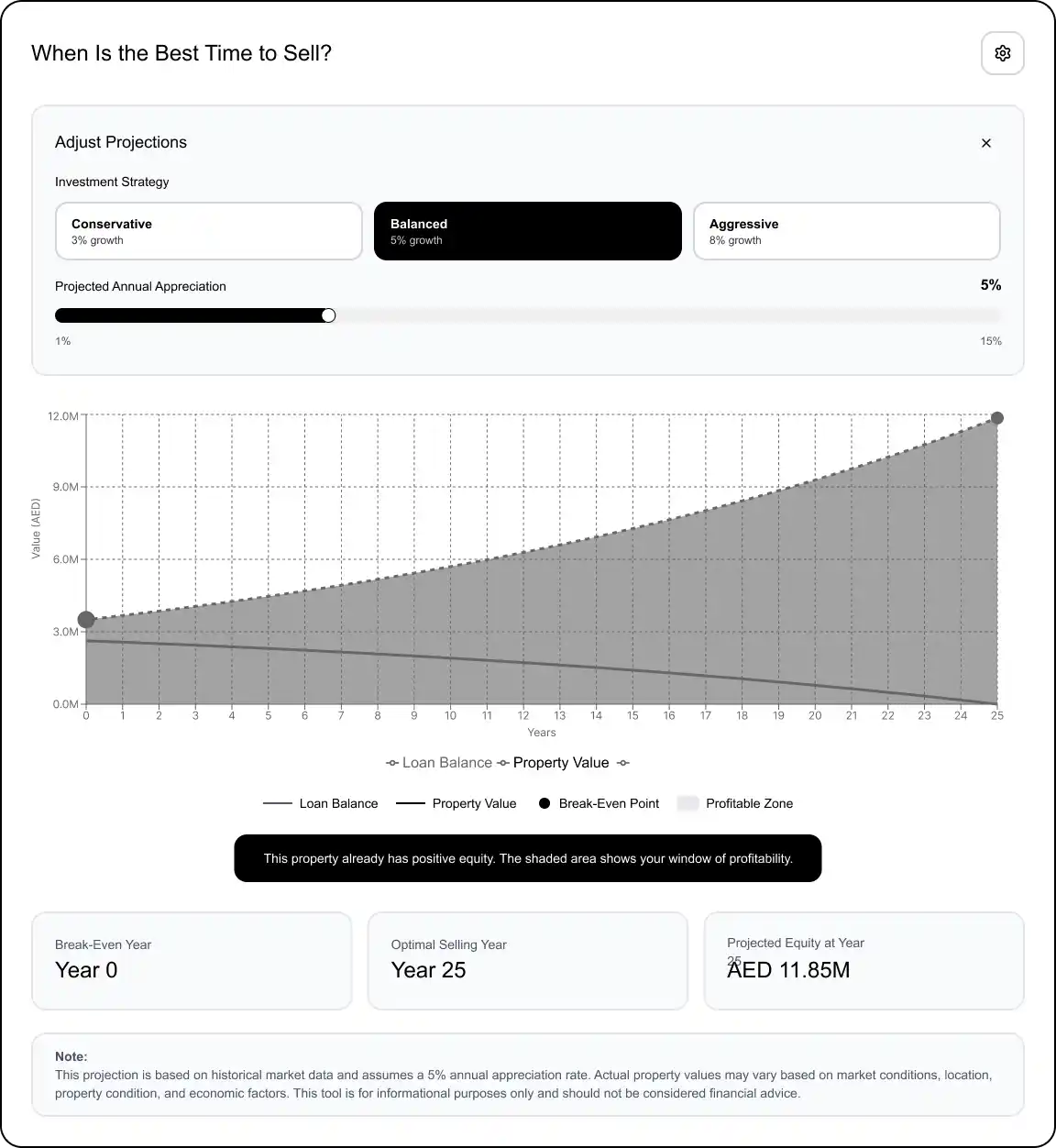
Optimal Selling Point

The graph showing the loan balance going down and the property value going up over time where they intersect is the starting point for selling with a profit. Everything after that is shaded, showing the profitable zone.

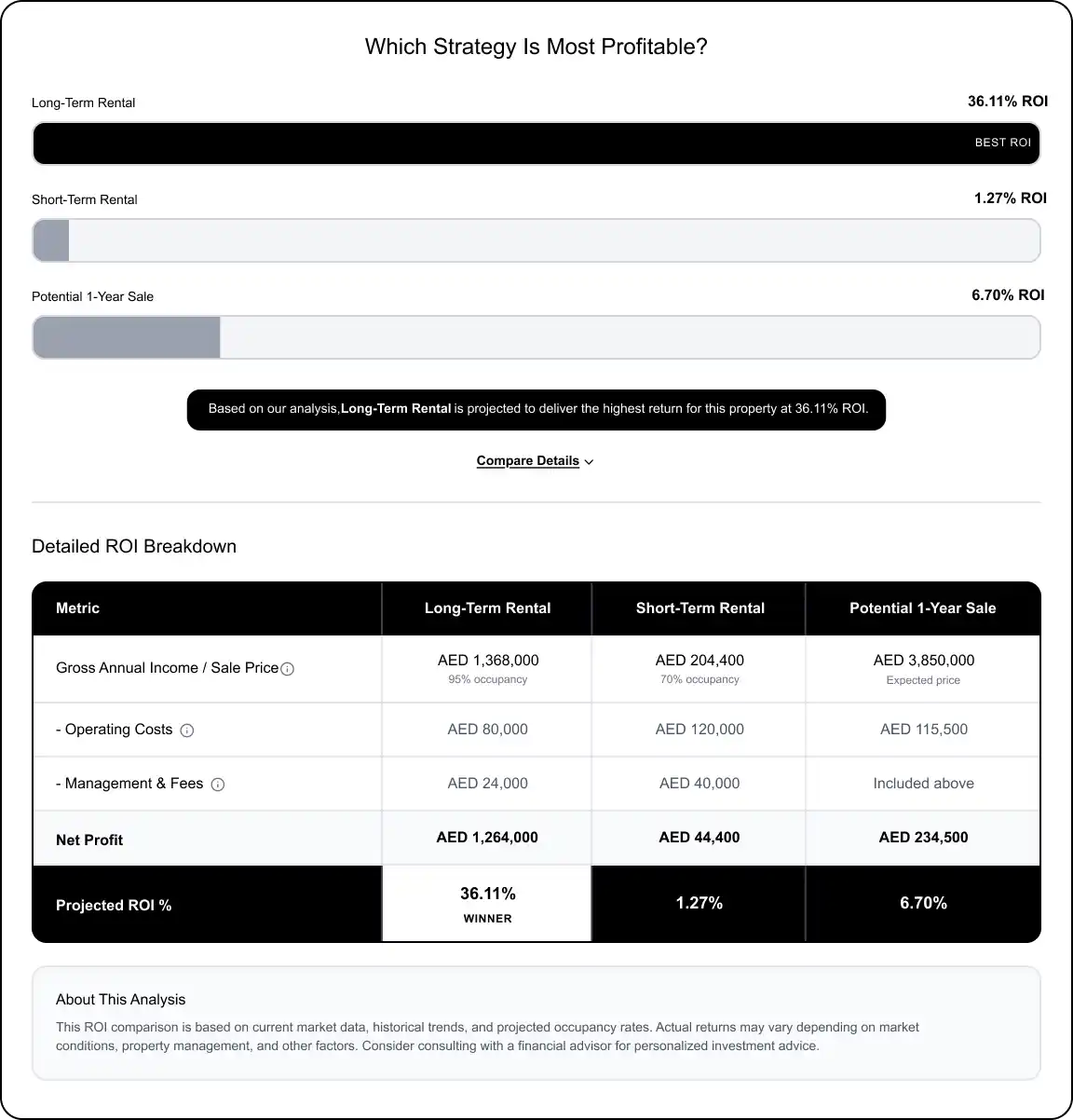
3 Way ROI Comparison

Optimal selling point graph help investors to know when the right time to sell the property and earn the profit. By adding the details of the property and the loan amount, the graph will show the comparison of the loan balance and the property.

Leasing Strategy Comparison

It will show a detailed comparison of both long term rental and short term rental strategies, give investors which will be more profitable for with detail split.

We got a twist middle of project

The original plan for PropertySearch.com was to build a property portal; however, stakeholders have since expanded this into a UAE lifestyle super app, which includes services such as visas, cars, furniture, cleaning services, health services, grocery services, etc., as well as the original property services. Partnerships have already been secured across all seven emirates; for Phase 2, we have now entered the super app space and have implemented new IA, a new homepage, new AI search flows, 50+ service categories, and a standardized booking system.

Phase 2 - Super App

Phase 2 Research

Research and design running in parallel

Unlike the research done during Phase 1, the research done during Phase 2 was a little different. With 8 categories of services and a number of subcategories to research and design for, the team decided to use a Lean UX approach where the team would research a category of services, identify the best UX pattern for the category, and implement the design system within the same sprint. This was aimed at identifying the best patterns so the system could be validated before applying it to the entire service categories.

Yes! there was decision taken while designing

No mixed cart

Each service has its own separate, independent transaction. The challenge was making each separate transaction feel intentional rather than fragmented, moving from a cart model to separate service flows.

01

Web and mobile application

Both platforms were launched simultaneously. This was due to the fact that early adopters of both platforms were assumed to use them on the desktop. All screens were developed simultaneously for both screen sizes without compromising either.

02

Hero shows AI search and categories together

Instead of a choice between search and browse, they both live in the hero the AI search bar up top for those who know what they want, category navigation directly below for those who are browsing.

03

Listings show services and providers

On the category page, service cards and provider cards are displayed. You can find what you need based on the service type or the provider.

04

One universal card component design

While designing cards, there is a single flexible card for all types of services, allowing us to modify tags, specs, and CTAs as needed without a new design for each content type.

05

Defining the Service IA

“How do you fit 50+ completely different services like private jets, maids, mortgages, groceries, visa applications into one app and make it navigable rather than overwhelming?”

The Solution

Every service was mapped and grouped into 8 top-level categories, then split further into subcategories. Within each category, services were separated into two types: Marketplace (buy, rent, or shop) and Services (book, apply, or get something done). This two-tier split meant users always knew the kind of action they were taking before going deeper.

The 3 Booking Flows

Although all of these services may seem unique, they are all built on only three main patterns: booking something, getting a quote or making a purchase. This ensures that all services are built on a consistent and easily understandable pattern.

Scheduled & On-Demand Booking

For services with clear availability and pricing

Inquiry & Custom Quote

For high-value or bespoke services requiring consultation

Direct Purchase & Checkout

For tangible goods and fixed-price services

User Flow Phase 2

Before jumping into screens, me and the team worked out the user flows for each feature and type of service. This involved thinking about how the user would enter, the decisions the user would have to make and where the flow would lead. Once the individual flows were worked out, we combined them to form one master flow to see how the entire product works together. This served as a reference point before any work on the HiFi began.

Phase 2 - Designs

Website Application

The super app homepage had a bigger job than the Phase 1 property portal homepage. It had to convey a much broader product one that extends from buying a property to booking a maid to applying for a visa without compromising the premium feel of the brand. It had to make users aware of what the platform has to offer immediately when they land on it while also allowing users to perform the most common activities such as searching and category navigation immediately.

Hero Section

The hero section is the first thing a user sees it needed to do two things at once: make the product feel premium, ambitious and immediately show users what they can do

Web Ai search result page demo

Category sections

Mobile Application

Onboarding Screens

Homescreen and category Screens

AI Search

Reflection & Learnings

Note

The product has not yet been launched. PropertySearch.com is an ongoing project. In this section, the design milestones completed, approved, and the build status are displayed. In an unreleased product, the design progress is the result.

What I have learnt so far

01

Learning to build complex financial data tools like Prosight and Investor Switch taught me that the point of the designer isn't to show the data; the point of the designer is to reveal the answer the data holds. Each and every chart, calculator and comparison had to culminate in a choice to be made.

02

This is also my first experience working directly with developers in a live business environment to learn how to work within their limitations, respect what's possible and then communicate that back to design in a way that works for everyone. The best design isn't what looks good on a screen; it's what gets built the way it was originally intended.

03

Using AI features involved both designing for the tools and utilizing - Figma Make, Gemini, GPTs within the process and I must say this is a new area of work and is becoming an essential part of product development and the way designers work and this project encouraged me to look at this seriously rather than superficially.

04

Having a Lead Designer and PM review my work regularly was a feedback loop that you just cannot replicate on a personal project. Learning how to take direction, how to iterate and not being precious about a direction not working out is a skillset that only really develops through actual commercial work.

05

Perhaps one of the largest lessons learned from Phase 2 is the concept of balance. A well-designed UI that's too complex to build or too heavy to run well is not a good design; it's an unfinished one. The balance between what's visually appealing and what's feasible is something I'm still getting used to, but I'm much more aware of it now than when I began this project.

Create a free website with Framer, the website builder loved by startups, designers and agencies.